With all the Changes in the World Who Would've Thought We Would Still be Talking About Oil
The “petrodollar” is best understood as a subsystem inside a much larger architecture of U.S. dollar dominance: dominant-currency trade invoicing, deep capital markets, global banking and credit intermediation, and the legal/institutional infrastructure around dollar assets. Oil pricing conventions matter, but the dollar’s structural advantages are broader than oil which is why headlines about “the end of the petrodollar” routinely overstate what is actually at risk. Oil’s macro importance has not faded with renewables because the world still runs on a set of hard constraints: a fossil-heavy energy base, liquid-fuels dependence in transport, and fast-growing non-combustion demand (petrochemical feedstocks). Meanwhile, the supply side is fragile because most upstream capital is spent just to offset decline from existing fields, and decline rates accelerate sharply without sustained investment. As of late March 2026, the war involving Iran and the effective closure/disruption around the Strait of Hormuz has moved the system from a “headline risk premium” episode toward a flow shock problem: even large strategic stock releases are finite stocks being used to cover a potentially persistent loss of daily seaborne flows, with limited bypass capacity. The near-term inflation question is less “does CPI spike?” and more “do second-round effects reawaken in an economy already conditioned by 2021–2023 inflation?”—a mechanism policymakers have explicitly flagged.
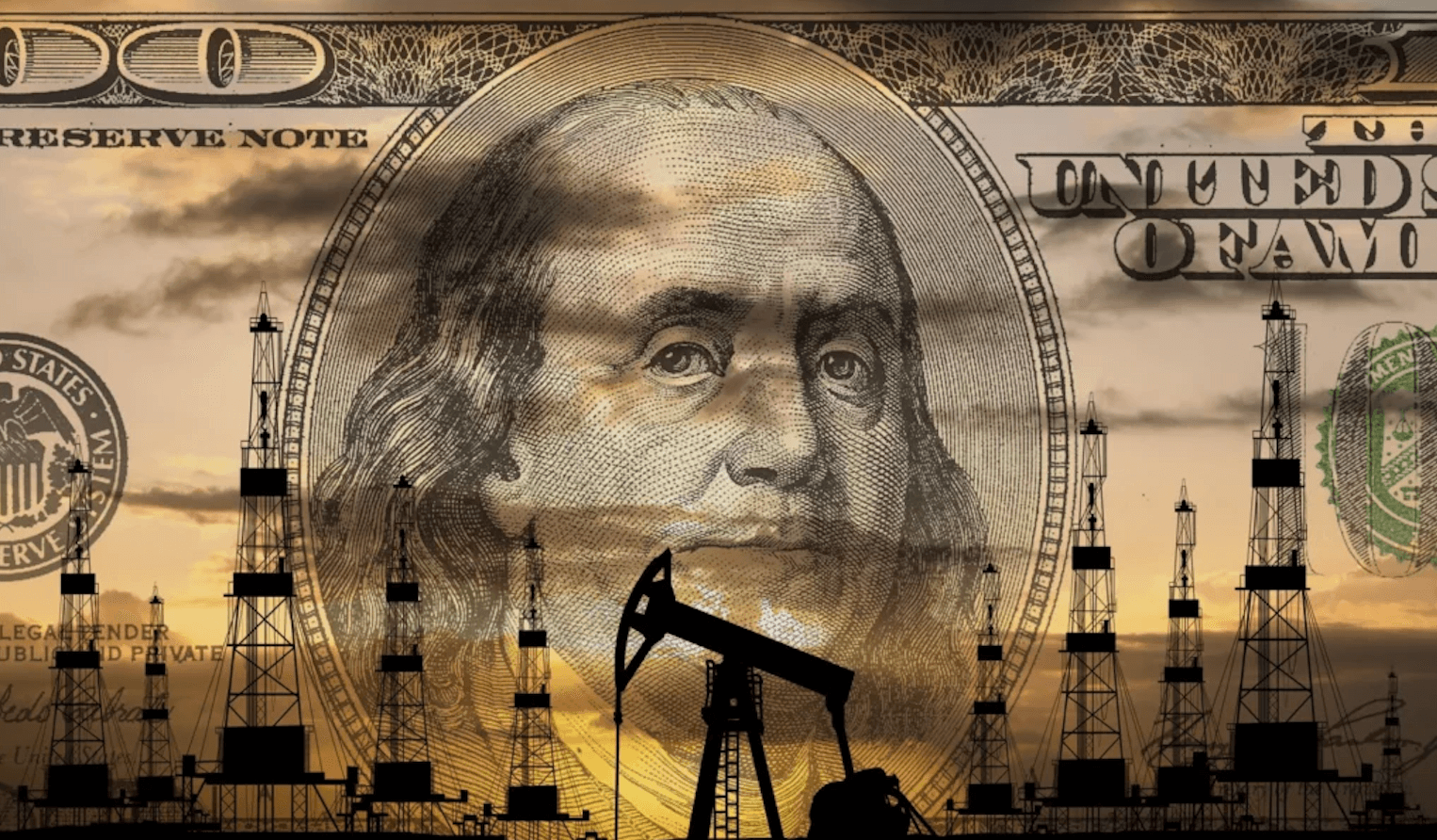
Petrodollar Mechanics Inside the Broader Dollar System
How the Post-Gold Era Set the Stage
The modern monetary regime begins with the early 1970s end of dollar convertibility into gold, which effectively dismantled the fixed-exchange-rate constraints of the postwar system and pushed the world into a dollar-centered fiat era.
In that setting, the 1973–1974 oil shock created massive current-account surpluses for oil exporters and acute balance-of-payments stress for importers—forcing what became known as "petrodollar recycling" through banks, official lending, and cross-border portfolio flows. The International Monetary Fund explicitly framed "recycling petrodollars" as a core stabilization task and created facilities to help oil-importing countries manage the shock.
What the "Petrodollar" Is in Practice
In practice, "petrodollar" dynamics are a combination of (a) pricing conventions and (b) reinvestment channels:
Oil benchmarks and derivatives that anchor global pricing are overwhelmingly quoted in U.S. dollars per barrel. For example, benchmark futures contracts such as ICE Brent are explicitly specified in "U.S. dollars and cents per barrel," reinforcing the dollar as the unit of account for global crude pricing and hedging.
The recycling channel is the more macro-relevant piece: oil exporters either spend receipts on imports or accumulate foreign assets (including bank deposits and bonds), and these flows affect global liquidity and asset prices. The Bank for International Settlements has documented how petrodollar cycles show up in international banking flows and how the pattern has evolved across episodes (e.g., less concentrated in banks than in earlier decades).
The U.S.–Saudi Pillar and Why It's Often Misunderstood
A persistent misconception is that there is a single, formal "treaty" that compels global oil to be sold only in dollars. The historical reality is more institutional: U.S.–Saudi cooperation after 1973 included economic coordination (e.g., the 1974 U.S.–Saudi Joint Commission on Economic Cooperation) and broader financial-market relationships that facilitated recycling and U.S. funding conditions.
The most important point for macro positioning is that even if some marginal barrels clear in other currencies, the pricing and hedging center of gravity can remain dollar-based as long as global benchmarks, liquidity, and risk management stay dollar-denominated.
Is the Petrodollar Fragmenting, and What Would Actually Break It?
Measured through outcomes rather than narratives, dollar dominance is pressured but resilient:
-
The dollar remains the dominant reserve currency, with COFER-based shares still around the high‑50% range and only modest quarter-to-quarter movement (e.g., ~56.8% in 2025Q4).
-
Trade invoicing is also concentrated in a small set of currencies—primarily the dollar—and recent IMF work finds the dollar's global invoicing dominance broadly stable even as fragmentation pressures rise; renminbi use has grown but remains modest in aggregate.
-
A realistic "break" would require multiple conditions simultaneously: (1) sustained producer willingness to shift benchmark pricing and derivatives liquidity away from USD, (2) a credible alternative pool of safe, liquid assets for recycling surpluses at scale, and (3) a global banking/payment infrastructure that can intermediate those flows with comparable depth. Those conditions are not met by "announcements" alone, which is why the market tends to overreact to symbolic de-dollarization headlines and underreact to slow-moving infrastructure and balance-sheet constraints.
-
Regarding BRICS initiatives: the key macro test is whether they measurably change reserve composition, trade invoicing, and cross-border credit stocks. Current data suggests incremental movement rather than a regime break.
Why Oil Still Dominates Despite the Energy Transition
The Energy Mix Reality: Transition Narratives vs. Base Load Facts
On the most basic arithmetic, the world remains fossil-heavy. The Energy Institute reports fossil fuels still underpin the energy system at roughly the mid‑80% share in 2024. Oil is still a ~one‑third pillar by many accounting methods, and global oil demand hit record territory (e.g., >101 mb/d in 2024 in the Energy Institute summary). At the same time, the IEA's accounting shows oil's share of total energy demand falling below 30% for the first time in 2024, illustrating how the "share" debate can be misleading: oil can lose share and still remain systemically dominant in absolute terms, pricing power, and input-cost transmission.
Demand Stickiness: It's Not Just Cars, It's Molecules and Mobility
A central market misread is to treat oil as synonymous with gasoline passenger vehicles. In reality:
-
The IEA attributes a large portion of recent oil demand growth to chemical feedstocks and aviation; it notes that in 2024, chemical feedstocks and aviation each contributed around half of oil demand growth in energy terms, while road transport has contributed only a small portion of growth since 2022.
-
Longer-run, the IEA has argued petrochemicals are poised to account for more than a third of oil demand growth to 2030 and nearly half to 2050—an outcome driven by plastics, fertilizers, and the difficulty of substitution across large swaths of industrial demand.
This is why rapid EV scaling can coexist with stubborn oil sensitivity: transport electrifies at the margin, while molecule demand grows through petrochemicals and aviation/shipping constraints.
Time-to-Transition Constraints Are Physical and Financial
Even in aggressive transition pathways, substitution is limited by capex cycles, supply chains, and grid/storage constraints; the Energy Institute's summary underscores that record renewable growth is occurring alongside record consumption of multiple major energy sources, not instead of them.
On the supply side, the IEA stresses that decline rates force an enormous reinvestment treadmill: it cites that nearly 90% of upstream investment is devoted to offsetting declines at existing fields, and without investment, decline can remove multi‑million b/d of supply each year; tight oil/shale declines are especially steep without continuous drilling.
Key near-term conclusion: the transition has reduced oil intensity at the margin, but the system remains oil-price sensitive because the marginal barrel still sets the price of a globally traded input into transport, industry, and petrochemicals.
Historical Oil Shocks and What They Teach About Today
A Regime Comparison Across Major Episodes
Below is a compact regime map using the same causal lens across major oil shock archetypes:
- 1973–1974: Embargo and production cuts by Arab exporters (OAPEC) caused a large price step‑change and macro disruption.
- 1978–1979: Iranian revolution and associated fear/hoarding dynamics amplified the price shock; the production decline and speculative behavior combined to generate outsized effects.
- 1990–1991: Iraq's invasion of Kuwait temporarily knocked out supply and raised prices; the abrupt production loss created a clear oil-shock episode.
- 2007–2008: A demand/financial cycle drove prices to an all-time nominal peak before collapsing with the global financial crisis; the run-up and subsequent collapse dynamics followed classic demand-destruction patterns.
- 2022: Russia's invasion of Ukraine triggered a broad energy and policy reappraisal, with Europe's gas/oil exposure becoming a major macro channel.
What Ends Oil Shocks vs. What Prolongs Them
Historical episodes suggest three common "endings," each with different macro signatures:
-
Supply restoration or credible rerouting ends a shock quickly (e.g., resolution of the acute supply-loss narrative in 1991 coincided with price normalization).
-
Demand destruction ends shocks brutally (2008 is the canonical case: the oil price collapse followed the sharp weakening of global demand during the financial crisis).
-
Policy credibility and anchored expectations determine whether shocks become "1970s-style" persistent inflation. IMF modelling work argues oil shocks alone do not mechanically generate 1970s stagflation—policy behavior and expectations dynamics matter critically.
When Shocks Turn Structurally Inflationary
The deepest historical lesson is that energy shocks become long-lived inflation problems when they trigger widespread second-round effects while monetary policy credibility is weak. The Federal Reserve's institutional history of the Great Inflation highlights how repeated oil crises contributed to inflation and growth sapping, but the persistence challenge is intertwined with the policy regime of the time.
More recent research revives the same theme in modern packaging: IMF work on second-round effects argues pass-through can be larger in high-inflation environments because firms/households become more attentive to price changes and more willing to reprice.
That mechanism matters in 2026 because policymakers across major blocs have explicitly referenced the risk that the 2022 inflation experience could accelerate pass-through today.
Middle East Chokepoints and the 2026 Iran–Hormuz Shock
Why Hormuz Remains the World's Most Dangerous Energy Bottleneck
The Hormuz chokepoint remains structurally irreplaceable at the scale that matters:
-
The IEA estimates around 20 mb/d of crude and products transited Hormuz in 2025—roughly a quarter of seaborne oil trade—while bypass pipeline capacity is limited (multi‑mb/d but far below chokepoint flows).
-
The EIA similarly emphasizes that very few alternative options exist if Hormuz is closed and quantifies flows around ~20 mb/d (about one‑fifth of global petroleum liquids consumption in 2024).
-
This is the critical structural point: the market can "solve" moderate Middle East disruptions with spare capacity and rerouting, but it cannot instantly rewire flows away from Hormuz at 15–20 mb/d.
What's Different in 2026: From Risk Premium to Flow Disruption
As of March 30, 2026, reporting across major outlets describes a rapid oil price surge tied to the war and disruptions at Hormuz, with global markets repricing energy as a central macro shock.
Policymakers have responded with unusually large emergency measures: the IEA announced a 400 million barrel release from member emergency reserves (its largest ever), while multiple countries pursued subsidies and price interventions.
Why reserves aren't a full solution (stock vs. flow): A 400 million barrel release is large, but it is still a finite stock meant to bridge a disruption, not replace a persistent multi‑mb/d loss of daily seaborne exports; several analyses note the implied flow gap is too large to cover indefinitely.
Spillovers Are Already Showing Up Outside Crude: Products, Petrochemicals, and Shipping Time
Markets often focus on crude, but the second-order system impacts propagate through refined products and industrial inputs:
-
Reuters reporting in late March 2026 highlights petrochemical and plastics supply disruption linked to Hormuz constraints, with knock-on effects across manufacturing margins and inflation pressures.
-
Shipping disruptions amplify the shock by raising freight and insurance costs and lengthening routes. Multiple reports describe rerouting away from Red Sea/Suez corridors and around Africa, adding roughly 10–14 days to transit times and generating sizable container surcharges.
This is the reason "peace headlines" may not instantly normalize inflation prints: logistics and product-market constraints can keep effective delivered costs elevated even if the front-month crude headline relaxes.
Does a Resolution End Geopolitically Driven Energy Volatility?
A durable end to Middle East–linked energy volatility would require structural mitigation, not just a ceasefire:
-
Physical bypass capacity is limited relative to the chokepoint scale, and the IEA notes sustainable flows at higher pipeline capacities are not fully tested, implying that even "available capacity" has execution risk.
-
The EIA's chokepoint framing reinforces the same logic: chokepoints can be circumvented only at the cost of time and shipping expense, and some have no practical alternatives at scale.
Inference: Even if the current conflict ends, the market will likely retain a structural volatility premium unless the world materially reduces Hormuz exposure via infrastructure (pipelines/ports), diversified supply chains, and/or material demand substitution. This inference follows from the scale mismatch between chokepoint flows and bypass options described by the IEA/EIA.
Inflation, Rates, and the Structural "Higher-for-Longer" Question
The Transmission Chain and Where Persistence Comes From
The basic chain remains: oil → input costs → producer prices → consumer inflation → wages/expectations → central bank response. Oil shocks are often "look-through" candidates for central banks, but persistence risk rises when inflation expectations and wage bargaining respond.
In March 2026, policymakers have explicitly highlighted this risk. Jerome Powell described the Fed as able to "wait and see" and emphasized distinguishing a short-term oil spike from structural inflation before changing policy. Christine Lagarde warned businesses may react more quickly to the oil shock because of memories of the 2022 inflation spike—i.e., second-round effects could arrive faster.
The current academic/policy literature is aligned with this concern: IMF research argues a high inflation environment can strengthen pass-through by reducing "rational inattention," increasing the odds that energy shocks bleed into core.
Policy Stance: Where Major Central Banks Are Right Now
As of the March 18, 2026 FOMC statement, the Federal Open Market Committee maintained the federal funds target range at 3.50%–3.75% and emphasized data dependence and risk assessment.
The European Central Bank held its key rates unchanged in March 2026 (deposit facility 2.00%), which sets a clear baseline for how much inflation persistence would be required to force renewed tightening.
Structural Inflation and Structurally Higher Rates: The Hinge Variables
The "structurally higher rates" case rests less on any single oil shock and more on:
-
Term premia and uncertainty about inflation, growth, and policy. The New York Fed publishes term premia estimates (ACM framework), and central banks emphasize term premia reflect uncertainty and risk compensation that can rise when regimes become less stable.
-
Fiscal supply and debt dynamics. IMF work finds measurable impacts of debt/deficits on long-term rates and term premia in the U.S., and IMF fiscal monitoring underscores higher global deficits and rising interest expense burdens—factors that can keep long rates structurally elevated relative to the 2010s.
-
Energy shocks now arrive into a world of constrained fiscal space and high debt, which can turn "temporary subsidies" into longer-run fiscal pressure and potentially higher term premia—a risk highlighted in contemporary coverage of energy-policy responses under high debt loads.
The U.S. "Energy Independence" Paradox: Why Global Prices Still Hit Domestic Consumers
Even with rising domestic production and net total energy export status since 2019, the U.S. remains a net crude oil importer and deeply integrated into global crude and product markets, meaning domestic prices remain tied to global marginal pricing.
The EIA's gasoline pricing decomposition makes the mechanism explicit: retail gasoline prices largely reflect crude oil costs plus refining, distribution, and taxes—so global crude repricing transmits mechanically into pump prices.
This is reinforced by the financial microstructure: key benchmark contracts are dollar-denominated and globally traded, pulling U.S. barrels into the same price formation ecosystem (benchmark competition, exports/imports of specific grades, and refining mismatches).
Forward Scenarios, Mispriced Risks, and Cross-Asset Implications
Scenario Set for 2026–2027
The ranges below are illustrative scenario bands for macro mapping rather than point forecasts; the key is the directional transmission through inflation expectations, term premia, and risk appetite.
Contained risk premium with partial flow normalization If Hormuz reopens meaningfully and tankers resume transit with credible enforcement, crude can fall materially from crisis highs; however, product markets and logistics may lag, so headline inflation cools faster than core. Central banks can plausibly stay on hold and reopen the path to gradual easing, conditional on inflation expectations staying anchored.
Protracted disruption with rationing-by-price If flows remain impaired for months (even without escalation), the world shifts into rationing via price: higher crude, higher product cracks, pressure on petrochemicals and transport, and renewed inflation anxiety. Under this path, the main macro risk is second-round effects: firms reprice faster, unions bargain harder, and term premia rise. Policymakers' "wait-and-see" posture becomes harder to sustain.
Escalation into broader infrastructure impairment A deeper escalation that threatens Gulf infrastructure or removes additional supply would likely trigger a classic stagflation setup: higher inflation and weaker activity. The IMF/OECD and European officials have already warned about growth downgrades and inflation uplifts under prolonged disruption scenarios.
Demand shock dominates: global slowdown "solves" the price If the shock tightens financial conditions enough to tip large importers into recession, oil can fall sharply via demand destruction even while geopolitics remain unstable (the 2008 template). This is the scenario where duration matters most: the longer the shock, the higher the probability of policy mistake + recession, and paradoxically the higher the odds oil prices eventually break lower.
What Markets May Be Underpricing
Stocks cannot replace flows indefinitely. The IEA's 400 million barrel release is historically large, but the system risk is daily flow loss through Hormuz at a scale that can dwarf reserve-release rates over time; this creates a non-linear duration problem.
Spare capacity can be "trapped" behind the chokepoint. Even if producers have capacity, the IEA notes that a disruption could strand a large share of effective spare capacity because much of it is held in the Gulf and relies on the same transit routes.
Second-order inflation may be faster in 2026 than in prior decades. Policy officials and IMF analysis both point to heightened sensitivity after years of elevated inflation, increasing the odds an energy shock bleeds into core inflation through faster repricing and wage demands.
Oil sensitivity is no longer just about gasoline—it's about products and petrochemicals. Product shortages, refining constraints, and petrochemical feedstock dynamics can transmit into broad CPI baskets through packaging, goods, and transport. Current reporting explicitly highlights petrochemical and plastics disruptions tied to Hormuz constraints.
Cross-Asset and Cross-Industry Mapping
Equities: Energy producers benefit from higher prices, but downstream and energy-intensive sectors face margin compression; history and current reporting highlight that products (diesel/jet) can move faster than crude, shifting winners toward refiners when cracks widen.
Fixed Income: The main hinge is whether inflation expectations remain anchored. The Fed and ECB have both signaled they can look through a temporary shock, but term premia can rise with uncertainty and fiscal supply, steepening curves even without immediate policy hikes.
FX: Classic patterns include a stronger dollar in risk-off episodes and worsening terms-of-trade for oil importers; modern ECB analysis notes oil price rallies can coincide with USD strength, intensifying imported inflation in other currency areas.
Countries: Large importers in India and parts of Europe face acute inflation/fiscal stress tradeoffs, which is why governments resort to excise cuts/subsidies while warning that measures must be temporary and targeted.
Implications for Investors and Policymakers
Investor Positioning
The current setup points to a regime where energy sits back at the centre of macro, with higher sensitivity across inflation, rates, and cross-asset correlations. The key shift is from a system that absorbed shocks quickly to one where disruptions carry through into real economic channels and persist longer than expected.
Positioning should reflect durability rather than short-term directional calls. Exposure to energy and commodity-linked cash flows becomes more valuable alongside inflation-sensitive instruments and assets with strong pricing power. Businesses tied to logistics, transport, and input-heavy production face ongoing margin pressure, especially where costs cannot be passed through quickly. Long-duration equities remain vulnerable as term premia adjust and rate expectations become less anchored.
Oil should be treated as a macro driver rather than a standalone trade. The more important signals sit in product markets, freight costs, inflation expectations, and the long end of the curve. Portfolio construction should account for wider outcome ranges, slower normalization, and a higher probability that volatility persists across cycles rather than reverting quickly.
Policy Considerations
The current shock is feeding through multiple channels at once—energy, logistics, industrial inputs, and expectations. The risk is less about the initial price move and more about how quickly it spreads into wages, services, and broader pricing behaviour in an economy that has already experienced elevated inflation.
Short-term policy should focus on stabilizing the system without extending demand pressures. Strategic reserves can smooth disruptions, while fiscal measures are best kept targeted and temporary. Broad subsidies risk prolonging inflation and adding pressure to already stretched public balance sheets. Monetary policy needs to remain steady, with clear communication around inflation expectations and the conditions under which policy would respond.
Over time, the priority shifts to reducing structural exposure. That includes expanding transport and export capacity outside key chokepoints, improving refining flexibility, and building supply chains that can absorb disruptions without amplifying them. Energy transition policy also needs to align with physical constraints, recognizing that oil demand remains embedded in the system over the medium term. A more resilient framework comes from reducing bottlenecks and maintaining policy credibility rather than relying on temporary interventions.
Summarizing Remarks
The “petrodollar” debate ultimately overstates the fragility of the system. Oil pricing matters, but the dollar’s dominance is anchored in much deeper foundations—capital markets, global banking, and institutional trust. What is actually shifting is but how flows move within the system, with more fragmentation and less automatic recycling into traditional channels.
At the same time, the energy system remains structurally tight. Oil demand is still supported by hard physical constraints, while supply requires continuous reinvestment just to offset decline. This creates a system that appears stable in normal conditions but is highly sensitive to disruption, where shocks move quickly from pricing risk to real supply constraints.
The current Iran–Hormuz disruption highlights that shift: the key issue the possibility of sustained flow shortages and second-round inflation effects alongside the temporary risk premium. In a post-2021 inflation regime, this raises the likelihood of more persistent macro volatility, tighter policy trade-offs, and a wider distribution of outcomes across markets.
Works Cited
-
The International Role of the U.S. Dollar – 2025 Edition — Federal Reserve
-
Currency Composition of Official Foreign Exchange Reserves — IMF COFER
-
Amid Regional Conflict, the Strait of Hormuz Remains Critical Oil Chokepoint — EIA
-
Nixon and the End of the Bretton Woods System, 1971–1973 — Office of the Historian
-
Saudi Arabian Joint Commission on Economic Cooperation — GAO
-
Causes and Consequences of the Oil Shock of 2007–08 — Brookings
-
Oil Price Shocks: Can They Account for the Stagflation in the 1970s? — IMF
-
IEA Member Countries to Carry Out Largest Ever Oil Stock Release — IEA
-
Crude Oil and LNG Supply Are at Risk of the Worst-Possible Scenario — Reuters
-
Iran War Chokes Petrochemical Supply, Sends Plastic Prices Soaring — Reuters
-
Morocco's Tanger Med Port Expects Increased Traffic Amid Gulf War — Reuters
-
Powell Says Fed Can 'Wait and See' How War Affects Inflation — Reuters
-
Top Central Banker Thinks Businesses May Be Quicker to Raise Prices Due to Iran War — AP News
-
The Impact of Debt and Deficits on Long-Term Interest Rates — IMF
-
Energy-Price Shock Hits a World Already Buried in Debt — WSJ
-
OECD: Iran War Erases Global Growth Upgrade, Fans Inflation — Reuters
-
India Cuts Excise Duties on Petrol, Diesel as Global Oil Prices Surge — Reuters