Why a Weaker Dollar is Inevitable Under Trump - And How Emerging Markets Will Win Big
Why a Weaker Dollar is Inevitable Under Trump - And How Emerging Markets Will Win Big Kabir Dhillon The U.S. dollar is on a path to weakening, and the global financial order is about to shift. A weaker dollar isn’t just possible—it’s inevitable. Trump’s potential return to the White House could accelerate the decline, with tariff wars, mounting fiscal deficits, and policy shifts pressuring the greenback. While this spells challenges for the U.S., emerging markets like China, India, and Brazil are poised to reap the benefits. A softer dollar means cheaper debt, surging foreign investment, and a commodity boom that could supercharge economies built on raw materials. Brazil’s markets are strengthening, India is attracting record capital inflows, and China is regaining its competitive edge. This article unpacks why the dollar must weaken, how it will reshape the global economy, and which markets are best positioned to capitalize on the shift.
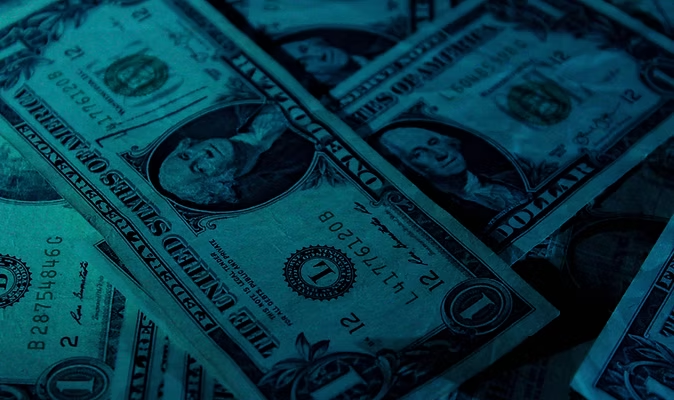
Why a Weaker Dollar Is Inevitable Under Trump — And How Emerging Markets Will Win Big
How a Weaker U.S. Dollar Fuels Growth in Emerging Markets
The U.S. dollar is the undisputed heavyweight of global finance, serving as the world’s reserve currency. It dominates international trade, is the primary currency for sovereign debt issuance, and is a benchmark for financial stability worldwide. Yet, when the dollar weakens, it sets off a chain reaction that disproportionately benefits emerging markets (EMs) like China, India, and Brazil. Understanding these dynamics is crucial for investors looking to capitalize on shifts in global currency trends.
Why Do Emerging Markets Benefit from a Weaker Dollar?
A declining U.S. dollar has three primary effects that drive growth in emerging markets:
- Lower borrowing costs
- Increased foreign investment inflows
- Commodity price boosts for exporters
Lower Borrowing Costs: Dollar-Denominated Debt Relief
Many emerging markets finance their infrastructure projects, corporate growth, and government expenditures through dollar-denominated debt. Since their economies lack deep, liquid capital markets, they often borrow in dollars to secure lower interest rates.
When the U.S. dollar strengthens, repaying this debt becomes more expensive in local currency terms, sometimes leading to financial distress, capital flight, and even economic crises. However, a weakening dollar eases this burden by making debt repayments cheaper, allowing governments and companies to reallocate funds toward growth initiatives.
Example: In 2017–2018, Argentina struggled with external debt repayments due to a strong dollar, which caused the peso to depreciate sharply and forced the country to seek IMF assistance. In contrast, during 2020–2021, a weaker dollar helped emerging markets stabilize their finances and reduce external debt burdens.
Surging Investment Inflows: Chasing Higher Returns
A declining dollar also triggers capital flows toward emerging markets, particularly when U.S. interest rates remain low.
- Lower U.S. yields = higher returns elsewhere: When the Federal Reserve keeps interest rates low and the dollar weakens, investors seek higher-yielding assets, often found in emerging markets.
- Equity markets surge: Since EMs often have higher GDP growth rates than developed economies, foreign investors shift capital into these markets, driving stock valuations higher.
However, these higher yields primarily benefit economies with stable macroeconomic fundamentals and healthy trade balances. Countries like Brazil stand to gain if the dollar weakens because their economies are heavily reliant on commodities. By contrast, weaker economies with structural issues may struggle to attract sustained investment.
Example: During the early 2000s commodity boom, Brazil saw significant capital inflows as bond yields remained high and fiscal conditions strengthened due to rising oil and iron ore exports. Conversely, Turkey, despite high yields, struggled to retain foreign investment due to persistent economic instability.
Commodity Exporters Gain Pricing Power
Since most global commodities — such as oil, gold, and agricultural goods — are priced in U.S. dollars, a weaker dollar increases the purchasing power of foreign buyers, driving up demand and prices. This disproportionately benefits commodity-exporting nations like Brazil, Indonesia, and Russia.
Example: In 2021, as the U.S. dollar declined due to loose monetary policy, oil prices surged past $80 per barrel, boosting revenues for countries like Brazil and Russia. Brazil’s trade surplus expanded significantly as demand for its agricultural and mineral exports increased.
Case Studies
China: The Yuan Strengthens, Imports Become Cheaper
China’s transition from export-driven growth to a consumption-driven economy makes it a prime beneficiary of a weaker dollar. When the yuan appreciates:
- Imports such as oil, metals, and semiconductors become cheaper
- Production costs for manufacturers fall
- Foreign investment rebounds as investors seek undervalued Chinese assets
- Dividend payments rise — Chinese firms paid a record $335 billion in 2024
Example: In 2017, when the dollar weakened after the Federal Reserve slowed interest rate hikes, China experienced strong equity inflows and increased consumer spending.
India: The World’s Fastest-Growing Major Economy
With projected GDP growth of 7% in 2025, India is one of the biggest winners of a weaker dollar:
- Foreign investment surges as global capital rotates away from U.S. assets
- The rupee strengthens, reducing inflationary pressures
- India’s tech and AI sectors thrive as capital inflows accelerate innovation
Example: In 2020–2021, as the dollar weakened post-pandemic, India attracted over $80 billion in foreign direct investment, particularly in technology and infrastructure.
Brazil: The Commodity and Dividend Powerhouse
Brazil’s commodity-driven economy thrives when the dollar weakens:
- Export revenues surge as commodity prices rise
- The Bovespa attracts capital with 6–9% dividend yields
- Government finances improve as tax revenues increase
Example: In 2010–2011, Brazil’s economy expanded rapidly as oil and iron ore prices surged alongside a weaker dollar, leading to a stock market rally.
Why the Dollar Would Be Weaker Under Trump
A potential second Trump administration could lead to a weaker dollar due to policies similar to those in his first term:
- Trade wars and tariffs: Reduced global demand for U.S. dollars as trade flows shift
- Fiscal deficits and debt expansion: Tax cuts and spending increases increase dollar supply
- Pressure on the Federal Reserve: Lower interest rates reduce the attractiveness of U.S. assets
- Re-industrialization and inflation: Domestic inflation pressures encourage accommodative policy
Conclusion
A weaker U.S. dollar creates favourable conditions for emerging markets by reducing debt burdens, attracting foreign investment, and boosting commodity-exporting economies. Countries like China, India, and Brazil stand to benefit as their economies become more competitive and their currencies strengthen.
Looking ahead, policies under a potential Trump administration could contribute to prolonged dollar weakness through tariffs, fiscal expansion, and monetary policy pressure. However, only emerging markets with strong macroeconomic fundamentals — such as Brazil — will fully capitalize on this trend, while weaker economies may struggle to sustain investor confidence.
References
International Monetary Fund. (2023). The Impact of a Strong U.S. Dollar on Emerging Markets
Federal Reserve Bank of St. Louis. (2022). U.S. Interest Rates and Capital Flows to Emerging Markets
U.S. Energy Information Administration. (2023). Oil Price Movements and the U.S. Dollar
World Bank. (2023). Commodity Price Outlook
Amadeo, K. (2022). How a Weak U.S. Dollar Affects the Global Economy. Investopedia
Reuters. (2023). Brazil’s Economic Boom Driven by Commodity Prices
Statista. (2023). FDI in Emerging Markets
CNBC. (2024). Why China and India Are Benefiting from a Declining Dollar
Bloomberg. (2023). The Trump Administration and the U.S. Dollar
Pressman, A. (2020). The Federal Reserve’s Role in Dollar Volatility. NerdWallet