In Pursuit of Prestige: The Rise, Risks, and Rewards of LVMH’s Empire
LVMH, the world's largest luxury conglomerate, is at a pivotal juncture, balancing remarkable growth with significant challenges. This article explores LVMH's strategic rise through acquisitions and brand innovation, while also addressing the cyclical nature of the luxury market and potential pitfalls. For investors, understanding these dynamics is crucial to evaluating LVMH's long-term potential as it continues to shape the future of luxury.
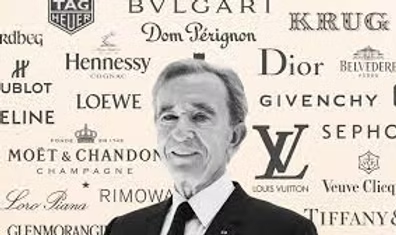
In Pursuit of Prestige: The Rise, Risks, and Rewards of LVMH’s Empire
Introduction
The luxury goods sector is undergoing a significant transformation, driven by shifts in consumer behaviour, evolving economic landscapes, and the relentless pace of innovation. Amid these changes, LVMH, the world’s largest luxury conglomerate, stands as a beacon of success—yet it is also at a crossroads that presents both opportunities and challenges. For investors, understanding LVMH’s trajectory is essential to evaluating its potential as a long-term investment.
This report examines LVMH through the lenses of rise, risk, and reward, offering a structured assessment of the company’s strategic positioning, vulnerabilities, and upside potential.
We begin by analyzing the forces behind LVMH’s ascent, including its acquisition strategy, brand stewardship, and access to private credit. We then assess the cyclical and structural risks facing the luxury sector. Finally, we evaluate the rewards available to investors should LVMH successfully navigate these challenges.
Rise
Smaller Brands
LVMH’s approach to smaller brands is defined by organic growth, brand diversification, and internal synergies. The company owns 75 brands across six sectors, including fashion and leather goods, wines and spirits, perfumes and cosmetics, watches and jewelry, selective retailing, and hospitality.
A decentralized organizational structure allows each maison to retain creative autonomy while benefiting from group-level capital, operational expertise, and global distribution. This balance has proven effective: LVMH generated €86.2 billion in revenue in 2023, representing a 9% increase from €79.2 billion in 2022.
By fostering creativity while maintaining financial discipline, LVMH enables even smaller houses to thrive within the conglomerate.
Dealmaking
LVMH’s rise has been fueled by disciplined yet ambitious dealmaking. The acquisition of Boussac, the parent company of Christian Dior, marked the foundation of its modern expansion strategy. Since then, LVMH has completed more than 40 acquisitions, strategically expanding across luxury verticals.
A defining example is the $14.5 billion acquisition of Tiffany & Co., which strengthened LVMH’s position in high-end jewelry and broadened its appeal in North America. Equally notable is the launch of Fenty Maison in partnership with Rihanna—the first fashion brand LVMH created from scratch since 1987. This collaboration marked a departure from traditional celebrity endorsements, granting Rihanna creative leadership and leveraging her cultural influence to reach younger demographics.
Through selective acquisitions and innovative partnerships, LVMH continues to set the standard for consolidation and value creation in luxury markets.
Private Credit
Private credit has reshaped corporate financing, particularly as traditional banks tightened lending amid economic uncertainty. LVMH has adeptly leveraged private credit markets to maintain flexibility and execute large-scale strategic transactions.
In April 2023, LVMH briefly entered the top ten global companies by market capitalization and became the first European firm to surpass a $500 billion valuation. Despite macroeconomic headwinds, LVMH’s revenues surged 17% in Q1 2023, driven by strong post-COVID demand in China and Japan.
The acquisition of Tiffany & Co. exemplifies LVMH’s effective use of private credit. Initially announced as an all-cash $135-per-share deal in 2019 and later renegotiated, the acquisition was supported by a landmark Eurobond issuance—the largest corporate issuance in euros since 2016. Several tranches were issued at exceptionally low or negative yields, effectively allowing LVMH to finance the acquisition at minimal cost.
Following Q1 2023, LVMH raised an additional €1 billion in corporate bonds, with demand exceeding €3.6 billion, reflecting strong investor confidence.
Risk
Navigating a Cyclical Market
Luxury goods are inherently cyclical. During economic expansions, rising disposable income and consumer confidence support demand. During downturns, discretionary spending contracts sharply.
Although LVMH’s diversified portfolio mitigates some cyclical exposure, it is not immune. The 2008 financial crisis demonstrated that even high-end consumers reduce luxury spending under economic stress. Firms such as Tiffany & Co., Coach, and Ralph Lauren experienced revenue and profitability declines closely correlated with GDP contraction, while luxury stocks underperformed broader indices like the S&P 500.
LVMH’s scale and diversification provide resilience, but macroeconomic shocks remain a material risk.
Failures
Luxury houses within large conglomerates face persistent tension between creative vision and financial performance. The collapse of Christian Lacroix illustrates this risk. Despite critical acclaim and Bernard Arnault’s backing, the brand failed to achieve profitability, accumulating lifetime losses of approximately €150 million and cycling through 14 CEOs.
Similarly, Kenzo—once a trailblazer under Kenzo Takada—faces questions around brand identity under its modern streetwear repositioning. These cases underscore the fragility of luxury brands when strategic alignment falters.
Pain Points and Future Challenges
LVMH faces multiple forward-looking challenges. Rising interest rates, persistent inflation, geopolitical instability, and potential recessionary conditions threaten consumer demand, particularly in Asia.
Additionally, the integration of generative AI presents strategic tension. While AI offers efficiency and personalization benefits, luxury fundamentally depends on craftsmanship, authenticity, and human connection. Poor execution risks brand dilution.
Luxury also faces structural contradictions: growth requires expansion, while exclusivity requires scarcity. Outsourcing production may improve margins but can undermine perceived quality. ESG concerns—including environmental impact and labour practices—add another layer of risk as investor scrutiny intensifies.
Rewards
Despite recent volatility, the luxury goods market is projected to grow from USD 284 billion in 2023 to USD 392.4 billion by 2030. As the sector’s dominant player, LVMH is well-positioned to capture a significant share of this growth.
LVMH’s emphasis on personalization, inclusivity, and brand storytelling aligns with evolving consumer preferences. Its ability to revitalize acquisitions—most notably Tiffany & Co., which has doubled sales since joining the group—demonstrates operational excellence.
The company’s diversified portfolio acts as a buffer against localized downturns, while its focus on high-net-worth consumers provides insulation from broader economic stress. Continued expansion into emerging markets and younger demographics further strengthens its long-term outlook.
Conclusion
LVMH’s journey through the global luxury sector highlights its ability to innovate, consolidate, and dominate—while navigating significant cyclical and structural risks. Its success hinges on balancing tradition with modernization, exclusivity with growth, and creativity with financial discipline.
For investors with a long-term perspective, LVMH offers exposure to durable brand equity, disciplined capital allocation, and the evolving future of global luxury.
References
ScienceDirect. (2022). The fashion industry is regarded as one of the most polluting industries in the world.
StockOpine. (2024). Dissecting LVMH’s dynamic presence.
Euromonitor. (2023). Three trends driving the global luxury goods market.
LVMH. (2024). World leader in luxury.
BBC News. (2023). LVMH hits new financial heights.
Financial Times. (2023). LVMH’s growing influence in global markets.
This communication is provided for informational purposes only and does not constitute investment advice. Past performance is not indicative of future results. St. George Capital does not guarantee the accuracy or completeness of this material and may engage in trading activities related to the securities discussed.
Copyright 2024 St. George Capital. All rights reserved.
outreach@stgeorgecapital.ca
27 King’s College Circle
Toronto, Canada