St. George Capital
Preparing St. George Capital
Loading the page and its supporting data.
St. George Capital
Loading the page and its supporting data.
Industrials / Specialty Industrial Machinery
GEV / NYSE
Source: Bloomberg, FactSet
| Quarter | EPS | Quarter | EPS |
|---|---|---|---|
| 2025E | 7.04 | 2027E | 18.21 |
| 2026E | 12.55 |
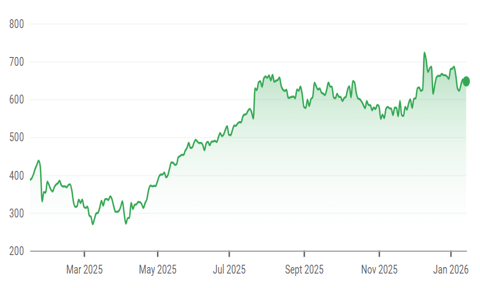
Most Leveraged Public-Market Play on the AI Power Supercycle
GEV sits on both sides of the bottleneck: 1. gas power generation and electrification equipment 2. as AI and hyperscale data centers drive a structural step-up in U.S. electricity demand not seen since the post-war industrial boom.
Q3 orders surged +55% YoY to $14.6B, confirming this is physical electricity demand, not just AI enthusiasm. Load growth is outpacing grid upgrades, creating an urgent, multi-year need for firm generation and grid equipment that GEV is uniquely positioned to supply.
The market still frames GEV as a legacy industrial spin-off rather than a structural beneficiary of the power supercycle. Consensus underestimates the duration and magnitude of the demand curve, historical electricity consumption data and third-party forecasts (McKinsey, NEMA, EIA) all point to demand inflecting well above trend through 2050.
Electrification Inflection Driven by Prolec GE & Grid Bottlenecks
Electrification is among the fastest-growing segments in global electrical equipment, with power transformer revenue forecast to nearly double from ~$50B to ~$95B by 2030, and GEV's Prolec GE acquisition locks in share at a ~7× EBITDA entry multiple, far below peers.
Severe transformer shortages and grid modernization are driving outsized demand. North America mix is rising to 40–50% of segment sales, and NA grid bottlenecks give GEV regional pricing power that asset-light peers lack. Prolec GE adds ~$0.8B in 2028 EBITDA.
The market has not yet fully priced in the margin and revenue uplift from Prolec GE, nor the scarcity value of owning physical transformer manufacturing capacity during a multi-year shortage cycle. Peers without installed NA capacity cannot replicate this positioning at comparable multiples.
Backlog Visibility & Operating Leverage Drive Earnings
A $135B+ total backlog provides multi-year revenue visibility, while 50–60% operating leverage amplifies pricing and volume gains, driving EBITDA from ~$1.6B (2024) to ~$9.8B by 2028.
Long-cycle equipment and high-margin services improve earnings quality. Backlog converts demand into predictable earnings, and the Electrification segment is inflecting from negative margins in 2022 toward double-digit margins by 2027–2028 per Barclays estimates.
Consensus models underweight the non-linear margin expansion inherent in GEV's operating leverage. A 6× EBITDA swing in four years is not priced into a stock still viewed through the lens of GE's legacy conglomerate discount rather than as a pure-play power infrastructure compounder.
GEV operates a long-cycle equipment + services model. Large equipment (gas turbines, transformers) is sold on multi-year contracts, often with locked-in pricing escalators. Service agreements generate recurring, higher-margin revenue over the installed base's 20–30 year life. Grid bottlenecks and transformer shortages give GEV regional pricing power in North America that asset-light peers cannot replicate.
Key cost drivers include raw materials (steel, copper, rare earth elements), manufacturing labor, and R&D across turbine and grid equipment platforms. The business benefits from 50–60% operating leverage, meaning incremental revenue drops through to EBITDA at outsized rates as fixed manufacturing costs are absorbed across higher volumes.
As GEV's installed base grows, the services mix increases as a percentage of revenue, driving structurally higher margins. Transformer manufacturing capacity (expanded via Prolec GE) is a scarce physical asset — competitors cannot quickly replicate it, meaning GEV's cost-per-unit advantage widens as utilization rises. The Power segment's LTSA book compounds as every turbine sold locks in decades of high-margin service revenue.
Siemens Energy (ENR) — Closest peer in heavy-duty gas turbines, but GEV's installed base is ~720 GW vs. ENR's ~80 GW. Siemens Energy's heavy exposure to loss-making wind operations and ongoing restructuring limits its ability to expand manufacturing at pace. Trades at ~31× forward EPS (see: Competitive Landscape — Siemens Energy).
Schneider Electric (SU) — Competes in transformers, switchgear, and substations. Strong global footprint but more automation-heavy portfolio. GEV is better positioned in large-format grid hardware that utilities urgently need. Trades at ~20–25× forward EPS (see: Competitive Landscape — Schneider Electric).
Mitsubishi Heavy — Competitive in turbines but significantly smaller in global market share and has less exposure to U.S. utility and hyperscaler demand. Trades at ~43× forward EPS (see: Competitive Landscape — Other Competitors).
ABB / Emerson — Strong in industrial automation but lack the large-scale transformer and high-voltage hardware footprint that GEV gains through Prolec GE (see: Competitive Landscape — Other Competitors).
No single competitor matches GEV's breadth across both firm generation (gas turbines, nuclear) and grid infrastructure (transformers, substations, high-voltage equipment). With quarterly orders of $14.6B and a combined backlog of $135.3B, GEV is uniquely positioned to serve the full energy-infrastructure buildout. Gas turbine pricing has roughly doubled to ~$2,300–2,600/kW vs. a few years ago, and GEV is ramping toward a production ceiling of ~20 GW/year by 2027 (see: Competitive Landscape — Siemens Energy; Key Risks — Mitigants).
Secular Trends: AI-driven electricity demand creating a structural step-up in U.S. power consumption not seen since post-war industrialization. Global electrification of transport, heating, and industry pulling forward decades of grid capex. Policymakers emphasizing energy security and grid resilience (see: Industry Overview — all three subsections).
Cyclical Factors: Utilities entering multi-year replacement cycles for critical equipment (transformers, switchgear). GEV's gas turbine production is sold out through 2028, with orders extending into 2029–2030. Hyperscaler data center orders reached ~$900M YTD in Electrification alone, already exceeding full-year 2024 levels (see: Near Term Catalysts).
Barriers to Entry: Manufacturing heavy-duty gas turbines and large power transformers requires decades of engineering IP, regulatory certifications, and massive capital investment. GEV's 720 GW installed base creates a locked-in services annuity. The Prolec GE acquisition added scarce North American transformer manufacturing capacity in a market with multi-year delivery backlogs — new entrants cannot replicate this positioning quickly (see: Competitive Landscape; Key Risks — Mitigants).
Energy security legislation and decarbonization policy are pulling forward utility capex on grid hardening, transmission expansion, and firm generation backup. Lengthy permitting for new power lines creates additional bottlenecks that favor incumbents with existing manufacturing and delivery infrastructure. Nuclear regulatory approvals (relevant to GEV's small modular reactor program) take years to obtain, representing a significant barrier (see: Industry Overview — Energy Security; Industry Overview — Electrification & Renewables).
Updated 2028 financial guidance release (Investor Day)
CEO has signaled the revision will primarily reflect margin expansion, not just top-line growth. An upward revision to 2028 EBITDA guidance (currently ~$9B–$9.8B) would force Street consensus higher, compressing the forward multiple and justifying the current premium valuation. Could trigger a re-rating if margin targets exceed expectations.
Q4 2025 / Q1 2026 earnings — backlog margin step-up confirmation
Analysts expect "another large increase" in backlog margins in Q4 2025 and an even larger step-up in Q4 2026 as higher-priced gas turbine orders (~$2,300–2,600/kW) begin converting to revenue. Earnings beats driven by pricing flow-through would validate the operating leverage thesis and support EPS estimates of $12.55 for 2026E.
Headline hyperscaler / data center power partnership announcement
GEV booked ~$900M YTD in Electrification orders from data center projects alone (already exceeding full-year 2024). A major announced partnership with a hyperscaler (e.g., Microsoft, Google, Amazon) to power new server farms would signal GEV as the go-to infrastructure provider, adding to backlog and potentially expanding the multiple on Electrification earnings.
rolec GE integration and North American transformer capacity ramp
Prolec GE is expected to add ~$0.8B in 2028 EBITDA at a ~7× acquisition multiple vs. peers trading at ~21×. As capacity comes online and North America rises to 40–50% of Electrification sales, the segment's margin profile should inflect from negative (2022) toward double-digit operating margins by 2027–2028. Successful integration de-risks the EBITDA bridge and could drive upward estimate revisions.
Gas turbine production ramp toward ~20 GW/year ceiling by 2027
GEV's gas turbine slots are sold out through 2028 with orders extending into 2029–2030. As manufacturing capacity ramps, revenue conversion from the $84B Power backlog accelerates. Each incremental GW of delivery at 50–60% operating leverage drives outsized EBITDA contribution, supporting the trajectory from ~$1.6B (2024) to ~$9.8B (2028).
Potential dividend initiation or shareholder return program
GEV has not yet initiated a dividend, prioritizing reinvestment and deleveraging post-Prolec. As free cash flow scales toward the company's 90–110% FCF conversion target by 2028, the introduction of a capital return program would broaden the investor base (attracting income-oriented funds) and signal management's confidence in the durability of the earnings ramp.
Our primary valuation approach is a Sum-of-the-Parts (SOTP) analysis, which we believe best captures GEV's distinct segment-level growth and margin profiles. We cross-check this against a forward P/E multiple framework.
| Company | Ticker | Forward P/E | Notes |
|---|---|---|---|
| GE Vernova | GEV | ~47× (2026E) | Premium justified by superior growth visibility |
| Siemens Energy | ENR | ~31× | Weighed down by wind losses and restructuring |
| Mitsubishi Heavy | 7011.T | ~43× | Smaller global share, less U.S. exposure |
| Schneider Electric | SU | ~20–25× | Automation-heavy, less grid hardware leverage |
| ABB | ABBN | ~20–25× | Lacks large-scale transformer footprint |
| Eaton | ETN | ~21× EBITDA | Relevant Prolec GE acquisition comp |
GEV's premium to peers is warranted given its dual exposure to both firm generation and grid infrastructure, $135B+ backlog, and 6× EBITDA growth trajectory (2024–2028).
The most relevant transaction is GEV's own acquisition of Prolec GE for $5.3B at ~7× 2028E EBITDA — a significant discount to peer Eaton, which trades at ~21× EBITDA. This implies the market has not yet fully priced in the accretive value of Prolec's North American transformer capacity within GEV's Electrification segment.
Using Barclays' 2028E EBITDA of ~$9.8B (including Prolec GE) and Wells Fargo's EBITDA composition (~67% Power, ~33% Electrification, Wind negligible):
| Segment | 2028E EBITDA | Multiple | Implied EV |
|---|---|---|---|
| Power | ~$6.6B | 17× | ~$112B |
| Electrification | ~$3.2B | 20× | ~$64B |
| Wind | Negligible | — | — |
| Total EV | ~$177B | ||
| (+) Net Cash | ~$12B | ||
| Implied Equity Value | ~$189B | ||
| Implied Price / Share | ~$706 |
The SOTP-derived value of ~$706/share corroborates our base-case price target of $690, which applies 52–57× to 2026E EPS of $12.55. The slight discount reflects execution risks around Prolec integration and capacity ramp, while still recognizing GEV's structurally superior earnings growth and backlog visibility.
| Scenario | 2026E EPS | Multiple | Implied Value |
|---|---|---|---|
| Bull | ~$14 | 58× | ~$800 |
| Base | ~$12.55 | 52–57× | ~$690 |
| Bear | ~$10 | 40× | ~$400 |
The bull case rests on GEV delivering faster-than-expected earnings growth across both Power and Electrification, driven by stronger gas turbine pricing, accelerated Prolec GE integration, and deepening hyperscaler demand. In this scenario, the market re-rates GEV as a structural compounder rather than a cyclical industrial, expanding the forward multiple.
The bear case centers on execution failures and demand deceleration that prevent GEV from delivering on its ambitious EBITDA bridge from ~$1.6B (2024) to ~$9.8B (2028). The high expectations embedded in the current premium multiple leave limited margin for error.
Our bull and bear cases are anchored to the key swing variables in GEV's EBITDA bridge from ~$1.6B (2024) to ~$9.8B (2028): gas turbine pricing trajectory, Prolec GE integration pace, and the rate of Electrification margin inflection.
Probability weighting: We assign approximately 60% to the base case, 25% to the bull case, and 15% to the bear case. The skew toward base/bull reflects the structural nature of demand drivers (AI power buildout, grid modernization) and the fact that GEV's gas turbine production is already sold out through 2028 — limiting downside to revenue volume. The bear case requires multiple simultaneous failures (pricing softness, integration missteps, and demand deceleration), which we view as a lower-probability tail.
Key assumption differences:
| Variable | Bull | Base | Bear |
|---|---|---|---|
| 2026E EPS | ~$14 | ~$12.55 | ~$10 |
| Gas turbine pricing | Accelerates above $2,600/kW | Holds at $2,300–2,600/kW | Plateaus below $2,300/kW |
| Prolec GE 2028 EBITDA | >$0.8B (ahead of plan) | ~$0.8B (on track) | <$0.5B (delayed) |
| Forward multiple | 58× (re-rating) | 52–57× (maintained premium) | 40× (compression to peers) |
The SOTP cross-check (~$706/share on 2028E EBITDA) provides independent confirmation that our base-case PT of $690 is not dependent on aggressive multiple assumptions alone, but is supported by fundamental segment-level economics.
Supply Chain Constraints in Electrification
The Electrification segment faces global shortages of critical components, particularly high-voltage transformers. Delays could hinder GEV's ability to convert its $30.18B Electrification backlog on schedule, pushing revenue recognition into later periods and creating near-term earnings misses.
Offshore Wind Losses and Capital Diversion
GEV's Wind segment has been volatile and historically loss-making, with revenue falling 8% YoY in FY25 and ongoing EBITDA losses. Execution issues (cost overruns, blade failures, contract delays) could divert capital and management attention from the higher-return Power and Electrification segments.
General Execution Risk on EBITDA Ramp
GEV is targeting a ~6× EBITDA expansion from ~$1.6B (2024) to ~$9.8B (2028), requiring successful Prolec integration ($5.3B acquisition), manufacturing capacity ramp to ~20 GW/year, and workforce scaling — all simultaneously. There is little room for error at the current premium valuation (~47× 2026E EPS).
We initiate with a Buy recommendation and a 12-month price target of $690 (~+17% upside), based on a SOTP-derived valuation of ~$706/share cross-checked against a 52–57× forward P/E on 2026E EPS of $12.55.
GE Vernova is the most leveraged public-market beneficiary of the AI power supercycle — uniquely positioned across both firm generation (gas turbines, nuclear) and grid infrastructure (transformers, substations). A $135B+ multi-year backlog, 50–60% operating leverage, and the accretive Prolec GE acquisition support an EBITDA trajectory from ~$1.6B (2024) to ~$9.8B (2028). The current premium valuation is warranted by superior growth visibility that no single peer can match.
This report has been prepared by St. George Capital for educational purposes only. It does not constitute investment advice or a solicitation to buy or sell securities. St. George Capital and its members may hold positions in the securities discussed. Past performance does not guarantee future results. Investors should conduct their own due diligence and consult with qualified financial advisors before making investment decisions.